Insights &
Thoughts
Exploring the frontiers of software architecture, AI agents, and modern development practices.
Instant GraphQL and REST from Any Postgres Database: Introducing graphpg
If you avoided GraphQL because of resolver boilerplate, or found tools like Hasura too heavy, here is what a database-first Rust engine looks like.
Why Row-Level Security Is the Safest Place for Authorization in AI-Built Apps
Why AI coding agents leave tenant filters out of queries, and how PostgreSQL Row-Level Security (RLS) moves authorization into the database, where one short policy covers every query and is easy to review.
Why GraphQL and REST Should Share One Engine: What I Learned Building graphpg
What PostGraphile, Hasura and PostgREST got right, what I did differently in graphpg (one Rust engine for GraphQL and REST, one SQL statement per request, no plugins), and why the two APIs should come from one plan instead of competing.
How End-to-End Type Safety Turns 'Change It Everywhere' Into a List Your AI Agent Can Finish
Why AI coding agents miss places when you ask them to change something everywhere, and how types generated from the database (SQL, GraphQL SDL, OpenAPI 3.1, TypeScript) turn every miss into a compiler error. Measured on a 177-table schema.
graphpg
In-house built high-performance Rust engine that derives unified GraphQL and REST APIs (OpenAPI 3.1) directly from PostgreSQL catalogs with single-statement execution and end-to-end type safety.
PostgreSQL on Kubernetes in 2026: Crunchy Data PGO vs. CloudNativePG
An architectural evaluation of Crunchy Data PGO versus CloudNativePG in 2026. Comparing consensus, pgBackRest against Barman Cloud, GitOps ergonomics, and why we placed CNPG in trial alongside our adopted PGO standard.
CloudNativePG
Open-source, Kubernetes-native PostgreSQL operator leveraging native controller quorum and Barman Cloud, placed in trial for greenfield clusters and streamlined GitOps.
Crunchy Data PGO
PostgreSQL operator for Kubernetes powered by pgBackRest, adopted for mission-critical databases and complex multi-datacenter disaster recovery.
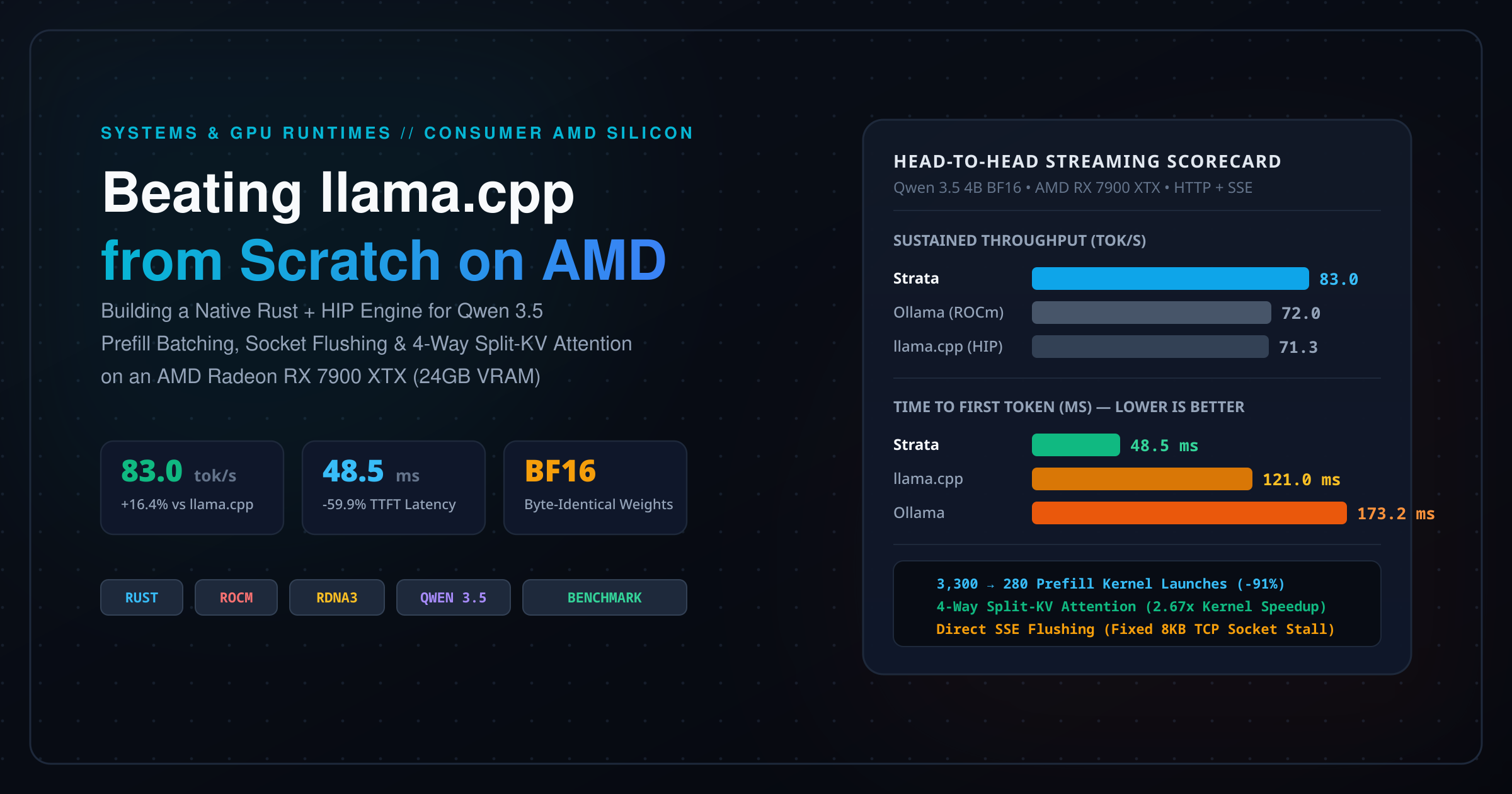
Beating llama.cpp from Scratch on Consumer AMD: Building Strata, a Native Rust + HIP Local AI Engine
Software Architect Mihai Farcas details engineering Strata: an ultra-fast local LLM inference engine for Qwen 3.5 on AMD Radeon RX 7900 XTX (gfx1100). How custom HIP kernels, split-KV reduction, and zero-allocation Rust beat llama.cpp and Ollama at 83.0 tok/s BF16 decode.
Showing 1 to 9 of 78 items