PostgreSQL on Kubernetes in 2026: Crunchy Data PGO vs. CloudNativePG
For years, database administrators repeated a familiar warning: never run relational databases inside Kubernetes. The argument was straightforward. Kubernetes treated compute instances as ephemeral cattle, whereas relational databases required stateful persistence, stable networking, and predictable disk I/O.
That dogma is obsolete. High-performance NVMe storage, CSI volume snapshotting, and production Kubernetes operators transformed stateful database deployments into standard practice.
For over three years, Crunchy Data PGO anchored our database infrastructure. As documented in our earlier production walkthrough (PostgreSQL Deployments with Crunchy Data Operator), PGO proved that automated failover, declarative connection pooling, and pgBackRest backups survive node evictions and disk failures.
In 2026, the landscape shifted. CloudNativePG (CNPG) reached feature parity and matured within the CNCF. Built from the ground up to leverage native Kubernetes primitives rather than wrapping legacy clustering tools, CNPG introduced a lighter, daemonless alternative.
This breakdown evaluates both operators across architecture, backup durability, GitOps ergonomics, and operational maintenance. It explains why Crunchy PGO remains our Adopted engine for complex enterprise retention, while CloudNativePG has entered Trial as our default for greenfield deployments.
Architectural Comparison
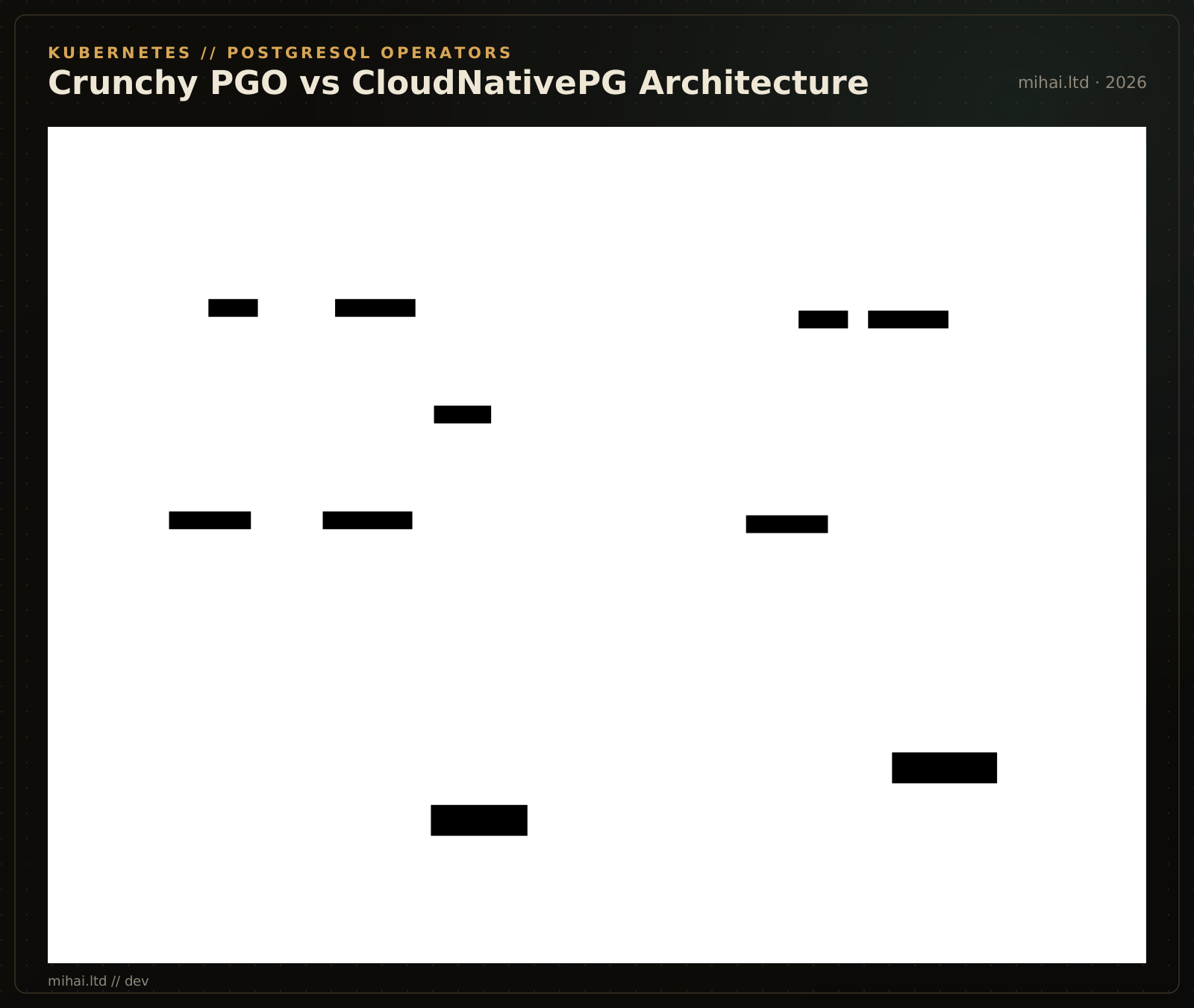
The fundamental difference between Crunchy PGO and CloudNativePG lies in how they integrate with the Kubernetes control plane.
Crunchy Data PGO: The Reconciler-Host Model
Crunchy PGO v5 uses a custom reconciler written in Go. It provisions PostgreSQL instances inside custom container images, manages TLS certificates, and relies on an external pod topology:
- Primary and standby pods run PostgreSQL alongside metrics exporters and logging sidecars.
- An isolated repository host pod (
repo-host) runspgBackRestwith dedicated storage. Database instances push Write-Ahead Logs (WAL) and backup payloads through this intermediate host. - PgBouncer instances run as separate, independently scalable Deployments with dedicated Service endpoints.
This architecture isolates backup workloads from active database instances. When an intensive snapshot begins, compute and memory overhead lands on the repo-host pod rather than degrading database transaction throughput.
CloudNativePG: The Daemonless Kubernetes-Native Model
CloudNativePG approaches Kubernetes natively. It avoids external consensus daemons like Patroni and rejects intermediate backup hosts:
- Each database pod runs a Go binary (
instance manager) as PID 1 to supervise PostgreSQL, configure replication, and intercept signals. - CNPG delegates leader election and failover coordination directly to native Kubernetes Leader Election Leases (
coordination.k8s.io). - Backups and WAL archiving stream straight to AWS S3, Cloudflare R2, or Google Cloud Storage via Barman Cloud, bypassing local repository pods.
By removing dedicated repository pods and external clustering software, CNPG reduces cluster idle memory by roughly 400MB to 800MB per database cluster.
Backup Durability: pgBackRest vs. Barman Cloud
A database operator is only as reliable as its restore path. Both operators provide automated backups, continuous WAL archiving, and Point-in-Time Recovery (PITR), but their underlying engines differ.
| Feature | Crunchy PGO (pgBackRest) | CloudNativePG (Barman Cloud) |
|---|---|---|
| Backup Engine | pgBackRest v2 | Barman Cloud |
| Architecture | Dedicated repo-host Pod | Embedded in-pod streaming |
| Delta Backups | Page-level binary diffs | Synthetic / incremental block backups |
| Multi-Repo Routing | Simultaneous writes (Local PVC + S3 + Azure) | Primary object store + replica sync |
| Standby Backups | Offloaded to standby or repo host | Supported on standby pods |
| Verification | Cryptographic block checksums | Manifest verification |
Why pgBackRest Keeps Crunchy PGO on "Adopt"
pgBackRest remains the most resilient backup system in the PostgreSQL ecosystem. Its page-level delta backups inspect database files at the 8KB page level. When taking an incremental backup of a 500GB database where only 2GB of data changed, pgBackRest transfers and stores only that 2GB delta.
Crunchy PGO also allows simultaneous multi-destination routing. A single database cluster can stream WAL segments simultaneously to:
- A fast, local NVMe PersistentVolumeClaim (retaining 48 hours for instant local PITR).
- An AWS S3 bucket (retaining 30 days for disaster recovery).
- A cold, cross-region Cloudflare R2 bucket (retaining 12 months for compliance).
If your regulatory environment demands independent physical backup destinations with distinct retention policies, Crunchy PGO delivers that out of the box.
The Barman Cloud Advantage in CloudNativePG
Barman Cloud takes a modern, cloud-first approach. Because it writes directly to object storage via HTTP API calls, it requires zero local scratch disks for staging backups.
For clusters running in environments with limited local storage, Barman Cloud eliminates the disk headroom anxiety associated with local backup volumes filling up during sudden data spikes.
GitOps Ergonomics: ArgoCD and Declarative Manifests
In a GitOps pipeline driven by ArgoCD or Flux, CRD design directly dictates developer velocity.
Crunchy PGO: Spec-Heavy, Explicit YAML
Crunchy PGO exposes deep operational control through its PostgresCluster resource. That control requires verbose configuration:
apiVersion: postgres-operator.crunchydata.com/v1beta1
kind: PostgresCluster
metadata:
  name: production-db
spec:
  postgresVersion: 16
  instances:
    - name: instance1
      replicas: 2
      dataVolumeClaimSpec:
        accessModes: ["ReadWriteOnce"]
        resources:
          requests:
            storage: 50Gi
        storageClassName: local-path
  backups:
    pgbackrest:
      image: registry.developers.crunchydata.com/crunchydata/crunchy-pgbackrest:ubi8-2.49-0
      repos:
        - name: repo1
          volume:
            volumeClaimSpec:
              accessModes: ["ReadWriteOnce"]
              resources:
                requests:
                  storage: 100Gi
          s3:
            bucket: prod-pg-backups
            endpoint: s3.eu-central-1.amazonaws.com
            region: eu-central-1
Notice the required boilerplate: explicit image definitions for backup containers, volume specifications for repository hosts, and nested instances arrays.
CloudNativePG: Intuitive, Minimal CRD Surface
The CNPG maintainers designed CloudNativePG with GitOps as a priority. A production three-node cluster with automated backups and PgBouncer pooling requires minimal configuration:
apiVersion: postgresql.cnpg.io/v1
kind: Cluster
metadata:
  name: production-db
spec:
  instances: 3
  postgresql:
    parameters:
      shared_buffers: "1GB"
      max_connections: "200"
  storage:
    size: 50Gi
    storageClass: local-path
  backup:
    barmanObjectStore:
      destinationPath: s3://prod-pg-backups/production-db/
      s3Credentials:
        inheritFromIAMRole: true
      wal:
        compression: gzip
Declarative changes—such as tuning shared_buffers or adding replicas—reconcile cleanly without triggering out-of-sync warnings in ArgoCD. When modifying database parameters, CNPG determines whether a simple pg_reload_conf() suffices or whether it must execute a rolling restart of standby instances.
High Availability and Failover Latency
Both operators ensure high availability through automated failover, but their mechanisms differ during network partitions.
The Failover Showdown
- Crunchy PGO: Relies on its custom controller loop. When a primary instance stops responding, the reconciler evaluates replication lag across standby pods, selects the most updated replica, issues promotion commands, and updates the Kubernetes Service endpoints. Typical failover duration: 10 to 18 seconds.
- CloudNativePG: Leverages Kubernetes API leases directly. The instance manager on standby pods monitors leader heartbeats. When lease renewal fails, the quorum promotes the standby immediately, with the instance manager taking ownership of the cluster state. Typical failover duration: 6 to 12 seconds.
During tests simulating abrupt worker node power-offs on bare-metal k3s nodes, CloudNativePG promoted standby replicas roughly 4 to 6 seconds faster than Crunchy PGO, primarily due to the absence of intermediate reconciler polling loops.
Modern Workloads: Vector Search & Extensions
In 2026, many PostgreSQL clusters run AI-driven workloads utilizing pgvector alongside standard relational tables.
- Crunchy PGO: Provides container images with
pgvector, PostGIS, and common extensions pre-compiled. Adding extensions outside their standard image requires maintaining custom Dockerfiles based on their UBI8 base images. - CloudNativePG: Offers pre-built images with extensions while providing a cleaner image customization workflow via standard Debian and Alpine container foundations. Enabling extensions in manifests is straightforward:
spec:
  bootstrap:
    initdb:
      postInitApplicationSQL:
        - CREATE EXTENSION IF NOT EXISTS vector;
        - CREATE EXTENSION IF NOT EXISTS "uuid-ossp";
Tech Radar Verdict
Our technology radar reflects practical operational boundaries rather than theoretical benchmarks:
[ ADOPT ]  ──▶  Crunchy Data PGO
                Battle-tested foundation. Retained for high-throughput
                production clusters requiring pgBackRest multi-repository
                durability and established operational runbooks.

[ TRIAL ]  ──▶  CloudNativePG (CNPG)
                Modern cloud-native standard. Designated as our primary
                choice for all greenfield clusters, developer sandboxes,
                and GitOps environments.
When to Standardize on Crunchy Data PGO
- You require pgBackRest's multi-repository architecture (writing to local storage and remote cloud providers simultaneously).
- Your operations team already possesses deep operational runbooks and automation around Crunchy's
pgoCLI and CRDs. - You are managing multi-terabyte datasets where page-level delta backups save network bandwidth and restore time.
- Detailed report: Crunchy Data PGO Tech Report.
When to Standardize on CloudNativePG
- You are deploying greenfield clusters and want minimal resource footprint without dedicated backup repository pods.
- You manage infrastructure strictly through ArgoCD or Flux and require clean, concise manifests.
- You want fast cluster bootstrap and sub-10-second failovers driven directly by native Kubernetes API leases.
- Detailed report: CloudNativePG Tech Report.