Monorepo Architecture: From Native Workspaces to Polyglot Build Systems
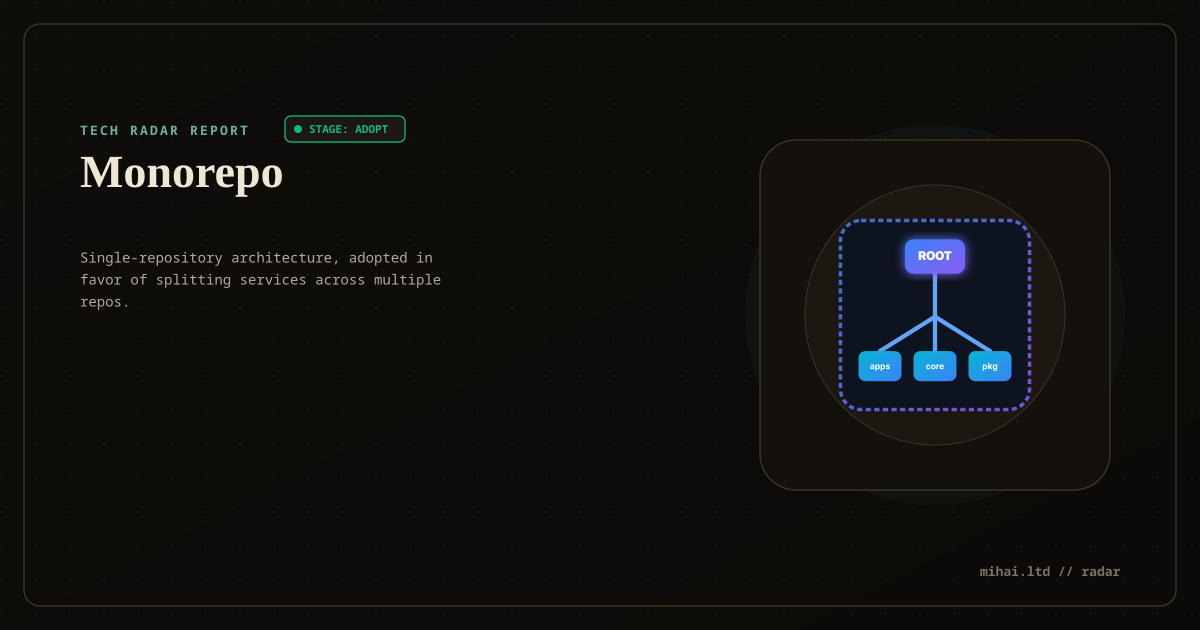
One repository for related services, libraries, and applications, rather than scattering them across a dozen disconnected repositories.
The most common objection to monorepos—"How do we maintain independent deployability?"—conflates code organization with artifact delivery. Independent deployment is a CI/CD pipeline concern, not a repository layout problem.
With path-based triggers, containerized builds, and targeted deployment pipelines, services in a monorepo deploy just as independently as polyrepo services. The difference is developer velocity: when a cross-cutting feature spans an API contract, two backend microservices, and a frontend client, it lives in a single atomic Pull Request. It is reviewed together, type-checked together, and merged without the fragile ceremony of semantic version bumping, registry publishing, and multi-repo deployment sequencing.
See also: Polyrepo, the alternative this was weighed against.
1. The Foundation: Native Package Manager Workspaces
Before reaching for heavy monorepo build orchestrators, every modern monorepo starts with native package manager workspaces.
Workspaces solve the fundamental code-sharing problem: allowing internal packages to depend on one another locally via symlinks without publishing intermediate packages to npm or PyPI.
pnpm Workspaces (TypeScript / Node.js)
In the JavaScript and TypeScript world, pnpm workspaces (configured via pnpm-workspace.yaml) is our adopted foundation, replacing legacy npm:
- Strict symlink isolation: Unlike npm or Yarn classic which flatten
node_modulesand invite phantom dependency bugs, pnpm's content-addressable store creates strict, isolated symlinks. - Workspace protocol: Using
"@org/shared-ui": "workspace:*"ensures internal dependencies always link directly to local source code during development. - Recursive commands: Commands like
pnpm --filter ./apps/web buildallow scoped execution across projects.
uv Workspaces (Python)
Historically, Python was notoriously painful in monorepos. Legacy tools like pip and requirements.txt (as well as Poetry and Pipenv) lacked native workspace semantics, forcing brittle pip install -e . hacks or complex path manipulation.
Astral's uv workspaces changed the game completely:
- Single unified lockfile: A root
pyproject.tomldeclares[tool.uv.workspace], resolving a single, deterministicuv.lockacross all microservices, shared libraries, and CLI tools. - Shared virtual environment: Rather than creating 15 separate virtual environments that each re-download PyTorch, FastAPI, or Pandas,
uvshares packages from its global cache and links internal packages instantly using{ workspace = true }. - Blazing performance: Written in Rust, uv resolves dependencies 10–100× faster than legacy pip.
2. Workspaces vs. Full Monorepo Tooling: When to Transition?
A common architectural mistake is adopting heavy build orchestration tools too early—or waiting until CI pipelines grind to a halt before realizing native workspaces are not enough.
What Native Workspaces Do Well:
- Local package linking and resolution.
- Dependency deduplication and unified lockfiles.
- Basic filtered command running (
pnpm --filter ...,uv run --package ...).
Where Native Workspaces Hit the Wall:
Native package managers have no concept of build graphs or computation caching. When you run pnpm -r test or uv run pytest, the package manager naively runs tests in every package—even if only a single markdown file changed.
When to Transition: Workspaces vs. Monorepo Engines
Comparing threshold criteria and the impact of distributed computation caching
Native Workspaces Are Sufficient When:
Keep your architecture lightweight. No extra build abstraction needed.
- ✓Small repository: Fewer than 5–8 packages or microservices.
- ✓Homogeneous stack: All-TypeScript or all-Python code.
- ✓Fast CI pipelines: Full test & build run takes under 3–5 minutes.
- ✓Linear execution: Simple task chains without complex cross-dependencies.
🎯 Verdict: Use standard pnpm-workspace.yaml or uv workspaces. Avoid premature build tooling.
Graduate to Monorepo Engines When:
Computation caching and affected analysis become business-critical.
- ▲CI bottlenecks: Pipeline execution times exceed 10–15 minutes.
- ▲Redundant work: Commits re-test unchanged modules (needs Git diff affected analysis).
- ▲Distributed Remote Caching: Need CI and developer laptops to instantly reuse build artifacts.
- ▲Polyglot architectures: Coordinating Python backend, TS UI, and Rust/Go binaries.
🎯 Verdict: Adopt Turborepo for pure TS, or Moon for polyglot multi-language pipelines.
CI Pipeline Run Time: Native Workspaces vs. Monorepo with Remote Caching
Time in Seconds (Lower is better)As the monorepo expands to 15+ packages, native package managers re-execute everything (taking 10–24 minutes), whereas smart engines with remote caching restore unaffected outputs in under 35 seconds.
Dedicated monorepo engines (Moon, Turborepo, Nx) introduce three transformative capabilities:
- Affected / Impact Analysis: Using Git diffs and dependency graphs to execute tasks only on packages affected by a commit.
- Computation Caching (Local & Remote): Hashing file inputs, environment variables, and dependencies. If the hash hasn't changed, the tool restores build and test outputs from cache in milliseconds.
- Task Pipeline Parallelism: Executing tasks topologically according to a defined graph (e.g. build shared UI before building web app, while running lint in parallel).
3. Homogeneous Stacks: Pure TypeScript vs. Pure Python
When your entire monorepo lives within a single language ecosystem, your tooling choice simplifies considerably.
Scenario A: Pure TypeScript / JavaScript
For pure TypeScript/JavaScript monorepos (e.g., Next.js/Nuxt web apps, Node/Fastify microservices, shared UI components, shared TS schemas):
- Turborepo is the recommended default. It is lightweight, configuration-minimal (
turbo.json), written in Rust, and focuses squarely on fast caching and task orchestration. It integrates seamlessly with Vercel and self-hosted remote caches without altering how your packages build. - Nx is a heavier, enterprise-grade alternative. It provides deep AST analysis, project visualizers, and code generators. However, it introduces significant abstraction that can feel intrusive for teams wanting standard build scripts.
Scenario B: Pure Python
- Base:
uv workspaces - Tooling:
uv+ruff
For a pure Python monorepo (e.g., several FastAPI microservices, shared data models, and Celery workers):
uv workspacespaired withrufffor linting and formatting is so ridiculously fast that many Python teams do not even need a secondary monorepo build orchestrator.- Tests can be scoped via
uv run pytest --package service-a, and dependency installation takes under 2 seconds. - You only need a monorepo task runner in pure Python if you have heavy, multi-stage artifact builds (e.g. compiling Cython/C-extensions, generating PyInstaller binaries, or baking complex multi-stage Docker images in CI) where distributed remote caching pays dividends.
4. The Polyglot Challenge: Multi-Language Monorepos
The real trial begins when a monorepo combines different language runtimes: Python backend services + TypeScript web applications + Rust/Go microservices or WASM modules.
Why JS-First Tools Struggle with Polyglot
Both Turborepo and Nx originated in the JavaScript/Node.js ecosystem:
- Turborepo expects
package.jsonfiles everywhere. It does not understand Python virtual environments, Cargo workspaces, or Go modules natively. Attempting to shoehorn Python tasks into Turborepo requires wrapping everything in custom npm scripts. - Nx supports Python through community plugins, but it can feel bolted on. Crucially, Nx assumes the developer’s local machine and CI runner already have the correct Python, Poetry, or Go versions installed and activated.
Moon (moonrepo): The True Polyglot Architecture
This is where Moon stands apart as the front-runner in our evaluation.
Moon was designed from day one as a language-agnostic, polyglot monorepo build system written in Rust:
- Hermetic Toolchain Management (
proto): Instead of assuming Node 20, Python 3.12, and Rust 1.80 are pre-installed on every developer's machine and CI container, Moon manages language runtimes natively via its toolchain system (proto). It automatically downloads, pins, and executes the exact runtime specified in.moon/toolchain.yml. Nonvm,pyenv, orrustupconfiguration drift. - First-Class Tier Support:
Moon treats JavaScript/TypeScript (
pnpm), Python (uv/pip), Rust (cargo), and Go as first-class citizens. Tasks are declared declaratively inmoon.ymlfiles per project:# apps/analytics-api/moon.yml (Python service) type: application language: python tasks: test: command: uv run pytest inputs: - "src/**/*" - "tests/**/*" lint: command: uv run ruff check . - Cross-Language Dependency Graph:
Moon allows cross-language task dependencies. For example, a TypeScript frontend build task can declare a dependency on a Python OpenAPI schema generation task or a Rust WASM compilation task:
Interactive Cross-Language Dependency Graph (DAG)
Visualizing topological task execution across Rust, Python, and TypeScript
Rust (cargo) Python (uv) TS (pnpm) ArtifactLoading interactive DAG chart...💡 Tip: Hover over nodes to trace dependency chains. Nodes can be dragged.Powered by Apache ECharts - Universal Unified CI:
Running
moon run :lintormoon run :testruns the appropriate linter and test suite across TypeScript, Python, and Rust in topological order, parallelizing where possible and caching every output.
5. Architectural Decision Matrix
| Dimension | pnpm / uv Workspaces | Turborepo | Nx | Moon (moonrepo) |
|---|---|---|---|---|
| Primary Scope | Package linking & lockfiles | JS/TS Task Orchestrator | Enterprise JS/TS Ecosystem | Polyglot Repository Orchestrator |
| Language Support | Single language (JS or Python) | JS / TS native (others via npm hacks) | JS / TS native (Python via plugins) | Node, Python, Rust, Go, Bun (Native) |
| Toolchain Management | None (host managed) | None (host managed) | None (host managed) | Built-in hermetic toolchains (proto) |
| Computation Caching | ❌ No | ✅ Local & Remote (Vercel/S3) | ✅ Local & Remote (Nx Cloud) | ✅ Local & Remote (AWS/GCP/moonbase) |
| Affected Detection | ❌ No | ✅ Git-based | ✅ Git + AST graph | ✅ Git-based |
| Config Overhead | Minimal (package.json/pyproject.toml) | Low (turbo.json) | Medium-High (nx.json + generators) | Medium (.moon/*.yml) |
| Best Fit For | Small or pure single-stack repos | High-velocity pure TS/JS repos | Large enterprise Angular/React setups | Polyglot Python + TS + Rust architectures |
6. Summary & Radar Verdict
- Architecture Decision: Adopt Monorepo. The developer experience of unified PRs, atomic cross-service refactors, and synchronized contracts far outweighs the multi-repo coordination overhead.
- Phase 1 Foundation: Always start with native workspaces—
pnpm workspacesfor TypeScript,uv workspacesfor Python. Keep things simple until build times demand orchestration. - Phase 2 Scaling:
7. Connected Deep Dives & Tech Reports
Explore the individual technology evaluations that form our monorepo web:
- Polyrepo (Rejected): Why multi-repo architectures failed our velocity tests and were rejected.
- pnpm (Adopted Standard): Content-addressable package management and workspace linking for Node/TS.
- npm (Rejected): Detailed analysis of phantom dependencies and flat node_modules liabilities.
- uv (Adopted Standard): The high-speed Rust toolchain powering our Python workspaces.
- pip (Rejected): Why pip and requirements.txt were retired in favor of uv.
- Turborepo (Adopted for TS): Task orchestration and remote caching for pure TypeScript monorepos.
- Moon (Adopted for Polyglot): Polyglot monorepo build system unifying Python, TypeScript, and Rust.
- Nx (Hold / Assess): Enterprise-scale monorepo tool with deep AST code analysis and generators.
- Bun (Trial): Fast JavaScript runtime, bundler, and package manager evaluated for edge services.